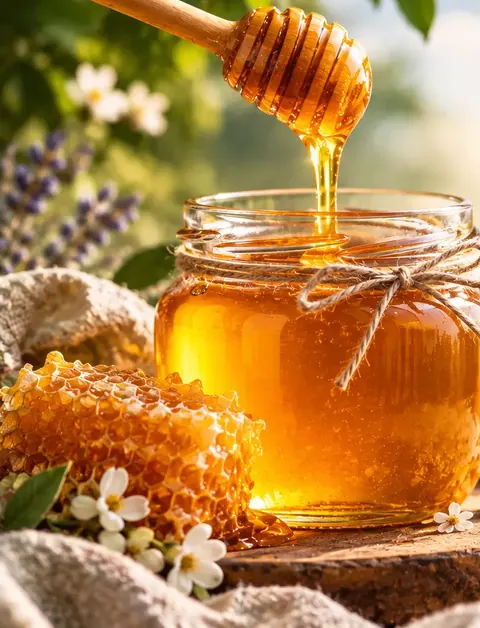
Honey crystallizes because it is a supersaturated sugar solution: it holds more glucose than the water in it can keep dissolved, so over time glucose separates out as tiny crystals. How quickly this happens depends mainly on the honey's glucose content and on storage temperature, with cool conditions around 10–15°C speeding it up. Crystallized honey is not spoiled and not fake, and you can make it liquid again by warming the jar gently in warm water, ideally keeping the honey below about 40°C.
That's the short answer. Below is the science in plain language, a step-by-step method, and the mistakes to avoid.
The science in three ingredients
Honey is mostly two sugars, fructose and glucose, plus about 17–20% water and small amounts of other substances. Think of it as more sugar than the water can comfortably hold.
- Glucose is the less soluble of the two sugars. It is the one that crystallizes.
- Fructose stays dissolved much more easily and helps keep honey liquid.
- Water content matters too: the lower the water, the more crowded the sugars.
So the key factor is the balance between glucose and fructose. Honeys rich in glucose crystallize fast; honeys with a lot of fructose stay runny for longer.
Seeds for crystals
Crystals need a starting point. Tiny particles of pollen, wax or existing micro-crystals act as "seeds". This is why raw, lightly strained honey often crystallizes sooner than heavily filtered supermarket honey, which has had most of these particles removed and has often been warmed to dissolve any early crystals. For more on that, see raw honey vs regular honey.
Temperature
Honey crystallizes fastest at cool room or cellar temperatures, roughly 10–15°C. At warm room temperature it slows down; in a freezer it barely changes because everything is too stiff to move. A typical kitchen cupboard in a Turkish winter is close to the ideal range for crystallization, which is why many people notice their honey "freezing" (donmuş bal) in the colder months.
Which honeys crystallize fastest?
| Honey type | Typical behaviour | Why |
|---|---|---|
| Many flower honeys (çiçek balı) | Weeks to a few months | Often relatively high glucose |
| Citrus honey | Fairly fast, fine creamy crystals | Fine crystal structure |
| Thyme honey | Moderate | Varies with the blend |
| Chestnut honey | Slow | High fructose |
| Pine honey (çam balı) | Very slow, can stay liquid for a long time | Honeydew honey, low glucose |
Because flowers and seasons vary, the same variety can behave differently from batch to batch.
Crystallized does not mean fake
A widespread belief in Türkiye says real honey always crystallizes, and another says real honey never does. Both are wrong. Crystallization is controlled by sugar composition and temperature. Pine honey naturally stays liquid; many flower honeys naturally set. Neither behaviour proves anything about added syrup. Only laboratory analysis can do that; we explain why in how to spot fake honey.
Is crystallized honey still good?
Yes. Crystallization is a physical change, not spoilage. The honey tastes the same and many people prefer the spreadable texture. It is excellent on toast and with kaymak because it doesn't drip.
One thing to watch: when only part of the honey crystallizes, the remaining liquid layer has slightly more water. If honey has high moisture to begin with, that layer can occasionally ferment. Signs are a sour, alcoholic smell, lots of bubbles or a bulging lid. That is a different problem from crystallization.
How to re-liquefy honey safely: step by step
The goal is to melt the glucose crystals with gentle, even heat. Honey is sensitive to high temperatures: strong heating darkens it, changes its flavour, lowers natural enzymes and increases HMF, a compound labs use as a heat and age indicator.
- Use a glass jar. If your honey is in plastic, spoon it into a clean, dry glass jar first.
- Loosen the lid so pressure doesn't build up.
- Prepare a warm water bath. Fill a pot with warm water, about 40–45°C at most. It should feel warm, not hot, to your hand. Use a kitchen thermometer if you have one.
- Stand the jar in the water, off the heat. The water should reach the level of the honey but not the lid.
- Wait and stir. Every 10–15 minutes, stir with a clean, dry spoon to break up crystals and spread the warmth.
- Top up the warm water as it cools. Patience matters; a large, fully set jar can take an hour or longer.
- Stop when it's smooth. Dry the jar, close the lid and store at room temperature.
Faster alternatives (with caution)
- Yoghurt maker or proofing setting: some ovens and appliances hold a low, steady temperature that suits this job.
- Sunny windowsill: in summer, a jar placed in warm (not burning) sun will gradually soften.
What not to do
- Don't microwave. It heats unevenly, creating very hot spots that overheat parts of the honey.
- Don't put the jar directly on the stove or in boiling water.
- Don't re-liquefy repeatedly. Warm only the amount you'll use soon.
How to slow down crystallization
- Store honey at a stable room temperature, roughly 18–25°C, not in the fridge.
- Keep the lid tightly closed; honey absorbs moisture from the air.
- Always use a dry, clean spoon.
- Buy a jar size you'll finish in a reasonable time.
Conclusion
Crystallization is simply glucose doing what it naturally does in a cool place. It doesn't harm the honey and it doesn't mean it's fake. If you prefer runny honey, a gentle warm water bath under about 40°C brings it back without overheating. Our raw flower honey may crystallize over time, which is completely normal; you can read about it on the product page or call us with any question before ordering.
Frequently asked questions
Does crystallized honey mean it is fake?
No. Crystallization depends on the honey's glucose content and storage temperature. Many genuine honeys crystallize, and some genuine honeys, like pine honey, rarely do.
Can I microwave crystallized honey?
It is not recommended. Microwaves heat unevenly and can overheat parts of the honey, affecting its flavour and natural enzymes. A warm water bath is gentler.
Should I keep honey in the fridge?
No. Cold temperatures make honey very thick and speed up crystallization. A closed jar at room temperature, away from sunlight, is best.
Is crystallized honey safe to eat?
Yes. Crystallization is a natural physical change and does not make honey unsafe. If it smells sour or fizzes, that indicates fermentation, which is a different issue.
Why did only the bottom of my honey crystallize?
Glucose crystals are denser and settle, so honey often sets from the bottom up, leaving a liquid layer on top. Stirring and gentle warming will even it out.