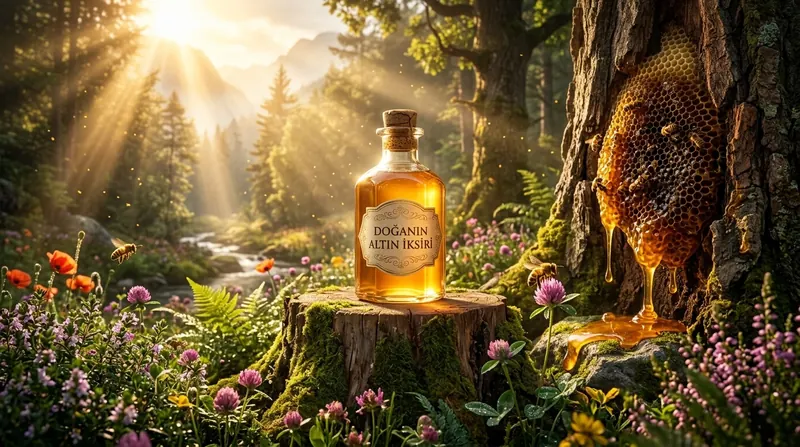
Anatolia produces unusually diverse honey because it combines several climate zones, a very rich native flora with many plants found nowhere else, locally adapted honey bees and a long tradition of moving hives with the seasons. Within a single country, bees can forage on Mediterranean citrus and pine, Black Sea chestnut, steppe herbs and high alpine meadows. Each landscape leaves its own signature in the honey's colour, aroma and texture.
Türkiye consistently ranks among the world's largest honey-producing countries, but its real distinction is variety rather than volume. This article explains where that variety comes from.
A meeting point of three plant worlds
Botanists divide the world into floristic regions, large areas with characteristic plant life. Anatolia is unusual because three of them meet here:
- The Euro-Siberian region along the Black Sea coast and northern mountains, with humid forests of beech, chestnut, alder and rhododendron.
- The Mediterranean region along the Aegean and Mediterranean coasts, with pine forests, maquis shrubland, citrus groves and aromatic herbs like thyme and sage.
- The Irano-Turanian region across the central and eastern interior, with dry steppe, rugged mountains and plateau meadows full of herbs, legumes and thistles.
Where these regions overlap, and where mountains create sharp changes in altitude over short distances, plant diversity is particularly high. Türkiye's flora is commonly estimated at well over ten thousand species and subspecies, and roughly a third of them are considered endemic, meaning they grow naturally only in this part of the world. That makes Türkiye one of the botanically richest countries in its part of the world.
For bees, this means an extraordinary menu, and for honey lovers it means an extraordinary range of flavours.
Climate: same country, different calendars
Anatolia's geography creates very different seasons depending on where you are:
| Region | Climate | Main flowering period | Typical honeys |
|---|---|---|---|
| Aegean and Mediterranean coast | Hot, dry summers; mild, wet winters | Early spring to early summer; honeydew into autumn | Pine (honeydew), citrus, thyme |
| Black Sea coast | Mild and rainy all year | Late spring to summer | Chestnut, mixed forest flowers |
| Thrace and Marmara | Transitional, moderately continental | Summer | Sunflower, clover, linden, mixed flower |
| Central Anatolia | Continental steppe; cold winters, dry summers | Late spring to mid-summer | Steppe flower honeys, sainfoin, thyme |
| Eastern Anatolia | Harsh winters; short, intense summers at altitude | Mid-summer | High plateau (yayla) flower honeys |
| Southeast | Very hot, dry summers | Spring and irrigated summer crops | Cotton, mixed flower |
The result is that somewhere in Türkiye, bees are finding nectar for much of the year, as long as beekeepers know where to go.
The bees: adapted to their landscapes
Plants are only half the story. Anatolia is also home to several native honey bee subspecies and many local ecotypes, shaped over a very long time by their particular climates. The best known are:
- The Anatolian bee (Apis mellifera anatoliaca), widespread across the interior and known for being hardy and thrifty.
- The Caucasian bee (Apis mellifera caucasica), found in the northeast, especially around Artvin and Ardahan, known for its long tongue, which lets it reach nectar in deeper flowers.
- Other regional types adapted to the Mediterranean, the eastern highlands and the Thrace region.
Türkiye has taken steps to protect some of these local populations, for example by limiting the movement of other bee types into certain areas. Locally adapted bees cope better with their region's weather and flowering patterns, which supports stable beekeeping and distinctive regional honeys.
Gezginci arıcılık: following the flowers
One of the most important reasons for Turkish honey diversity is migratory beekeeping (gezginci arıcılık). Many Turkish beekeepers move their hives by truck several times a year to follow the bloom. A typical route might look like this:
- Early spring on the coast. Hives start the season in the warm south and west, where citrus and early wildflowers bloom.
- Late spring and early summer inland. As the coast dries out, hives move to the central plateaus and lower mountains.
- High summer in the mountains. Many beekeepers take hives up to the yaylas (summer pastures) of the east and the Black Sea mountains, where meadows bloom late.
- Late summer and autumn in the pine forests. Hives return to the Aegean and Mediterranean, especially around Muğla, where bees collect honeydew from Turkish red pine to make pine honey.
This seasonal migration is why a single beekeeper may produce several quite different honeys in one year, and why a jar's label should ideally tell you where and when the honey was produced.
A few signature honeys and what makes them
Pine honey
Pine honey is not made from flowers at all. Bees collect honeydew, a sweet secretion produced by a small insect (Marchalina hellenica) that lives on pine trees. The Aegean and Mediterranean pine forests of southwest Türkiye are one of the world's main sources. Read our full guide to Turkish pine honey.
Chestnut honey
The humid forests of the Black Sea and Marmara regions are rich in sweet chestnut trees. Their honey is dark, strongly aromatic and slightly bitter, a love-it-or-hate-it taste. See Black Sea chestnut honey.
High plateau flower honey
On the eastern and northeastern plateaus, short summers produce an explosion of wildflowers. Honeys from these areas vary from year to year and valley to valley, reflecting whatever bloomed that season. Anzer honey from Rize is the best known example.
A note on "mad honey"
In parts of the eastern Black Sea, certain rhododendron species produce nectar containing natural compounds called grayanotoxins. Honey made largely from these flowers, known locally as deli bal, can cause poisoning, so it is not an everyday honey and should be treated with real caution. It is a reminder that "natural" and "harmless" are not the same thing, and that origin matters.
What diversity means for you as a buyer
All this variety is wonderful, but it also creates room for confusion and mislabelling. A few practical points:
- Expect variation. The same type of honey can differ in colour and taste between harvests. That is normal for a natural product.
- Check the origin. Ask where and when the honey was produced, especially for named regional honeys.
- Use lab tests. Pollen analysis can confirm whether a honey's botanical and geographic origin matches its label.
- Keep expectations realistic. Honey is a delicious food, mostly sugars and water. Enjoy it in moderation, and never give it to babies under 12 months.
For an overview of the main types and how they taste, see our guide to Turkish honey varieties.
Conclusion
Anatolia's honey diversity comes from a rare combination: three floristic regions meeting in one land, many endemic plants, sharply different climates, native bees adapted to them, and beekeepers who move with the seasons. Every jar is a small snapshot of a particular landscape at a particular time.
If you would like to taste Anatolian flower honey for yourself, you can see our raw flower honey. We confirm every order by phone, you pay by bank transfer (havale/EFT), and we ship once the payment arrives, with a tracking number. You are welcome to call with any questions about the honey first.
Frequently asked questions
Why is Turkish honey so diverse?
Türkiye combines several climate zones, three major floristic regions, a very rich native flora with many endemic plants, native honey bee subspecies and widespread migratory beekeeping. Together these produce a wide range of honey types.
What is migratory beekeeping in Turkey?
Migratory beekeeping, or gezginci arıcılık, means moving beehives several times a year to follow the flowering season, for example from coastal citrus in spring to mountain meadows in summer and pine forests in autumn.
Which honey bees are native to Anatolia?
Anatolia is home to several native honey bee subspecies and local ecotypes, including the Anatolian bee and the Caucasian bee, which is found mainly in the northeast.
Does the same type of Turkish honey always taste the same?
No. Because honey depends on which plants were in bloom and the weather of each season, colour and taste can vary between harvests and regions. This variation is normal for a natural product.